Define the outcome.
What should be different when the work is done? What does success actually look like, and what decision are we trying to improve?
DATA · AI · DECISION SYSTEMS
I turn complex data, ambiguous business questions, and emerging technology into systems that help people make better decisions.
Define the outcome. Find the constraint. Measure what matters. Simplify the system. Then automate.
The technology changes.
The thinking doesn't.
POINT OF VIEW
I've seen organizations begin with the dashboard. I prefer to begin with the decision. What are we trying to accomplish? What would tell us we're succeeding? What information would cause someone to act differently? Data becomes valuable when it changes what we do—not simply because we can measure it.
“The goal isn't more data. The goal is greater clarity.”
BEFORE I BUILD ANYTHING
I don't begin with a dashboard, a complex query, or an AI solution. I begin by understanding the outcome, the constraint, the evidence, and the people doing the work.
Technology can make a good process dramatically better. It can also make a bad process dramatically faster.
Understand it. Simplify it. Then use automation or AI where it creates measurable leverage.CONTEXT MATTERS
A database can tell me what happened. It does not always tell me why. Some of my most useful work starts with conversations—with operators, analysts, managers, and leaders who each understand a different part of the system.
I want to know what they are seeing, where work gets stuck, which assumptions may be wrong, and what decision they actually need to make. Then the data can test the story.
SELECTED WORK
SQL, BI, data engineering, visualization, and AI are tools. Their value is measured by what improves because they were used.
Reconstructed an assignment workflow through stakeholder interviews, then built SQL-driven routing logic around certifications, schedules, time zones, completion status, and reassignment rules.
Refactored legacy SQL and indexing logic while supporting supply-chain network strategy, returns analysis, logistics, store expansion, and delivery optimization.
Mapped operational workflows and SLAs to expose bottlenecks leaders could act on, including hiring-cycle differences across clinical roles.
An AI-assisted document-processing architecture focused on source fidelity, structured transformation, validation, lineage, provenance, and defensible downstream analytics.
SPEAKING & TEACHING
I've presented SQL, optimization, data modeling, standardization, and analytics practices at PASS Data Community Summit and SQL Saturday events, while also mentoring analysts on translating business requirements into scalable solutions.
Connect on LinkedIn →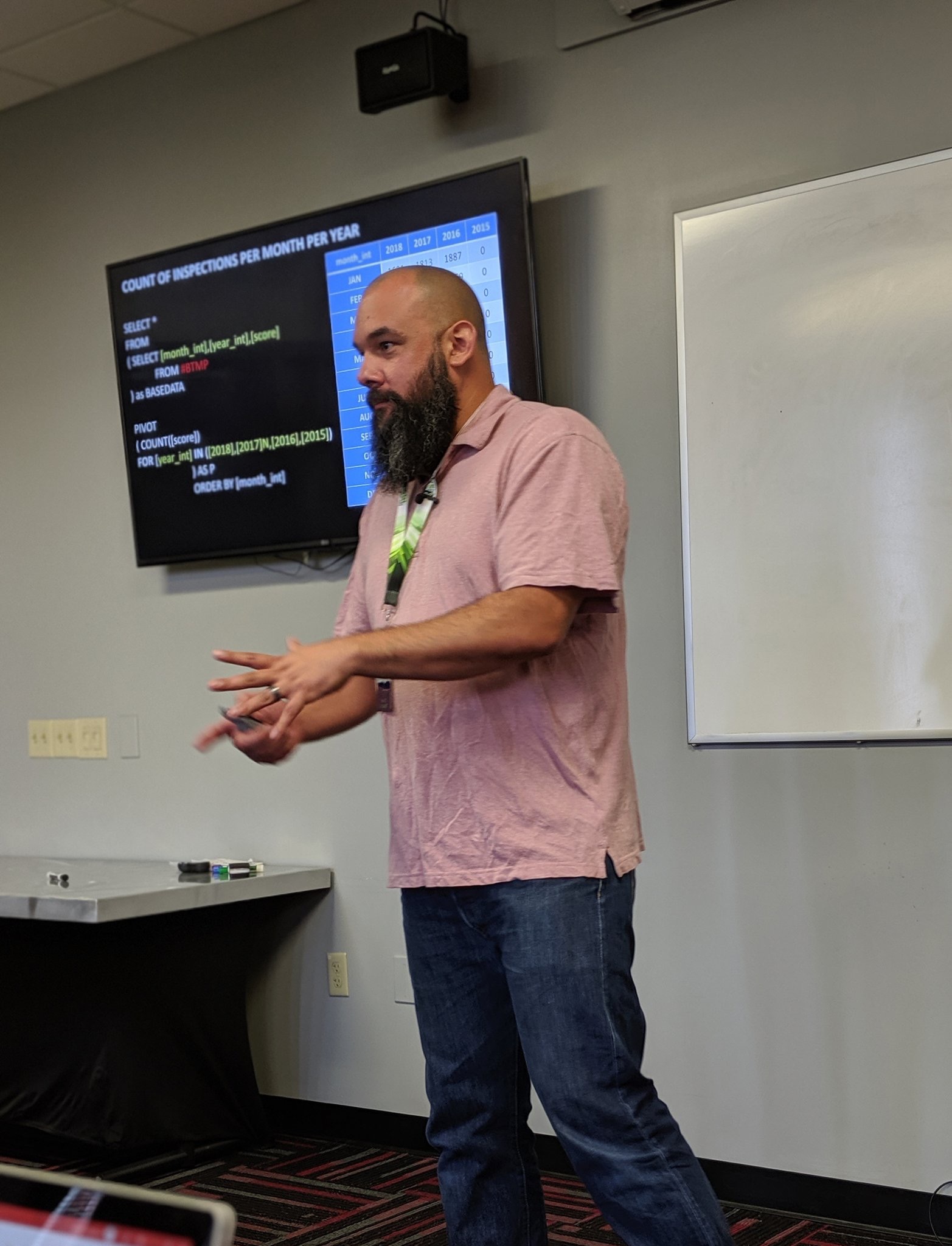
WHAT I'M BUILDING TOWARD
The next generation of valuable technical professionals will move between executives, users, data, systems, and models. They will understand the problem before selecting the technology, identify the real constraint, and build—not merely recommend. The objective is not more AI. It is a better system and a better decision.
LET'S TALK
Those are usually the interesting ones.